If everything is generated by AI, what remains original?
The reflection on creativity and originality in the age of generative artificial intelligence invites us to revisit some of the principal debates within twentieth-century art theory.
The reflection on creativity and originality in the age of generative artificial intelligence invites us to revisit some of the principal debates within twentieth-century art theory.
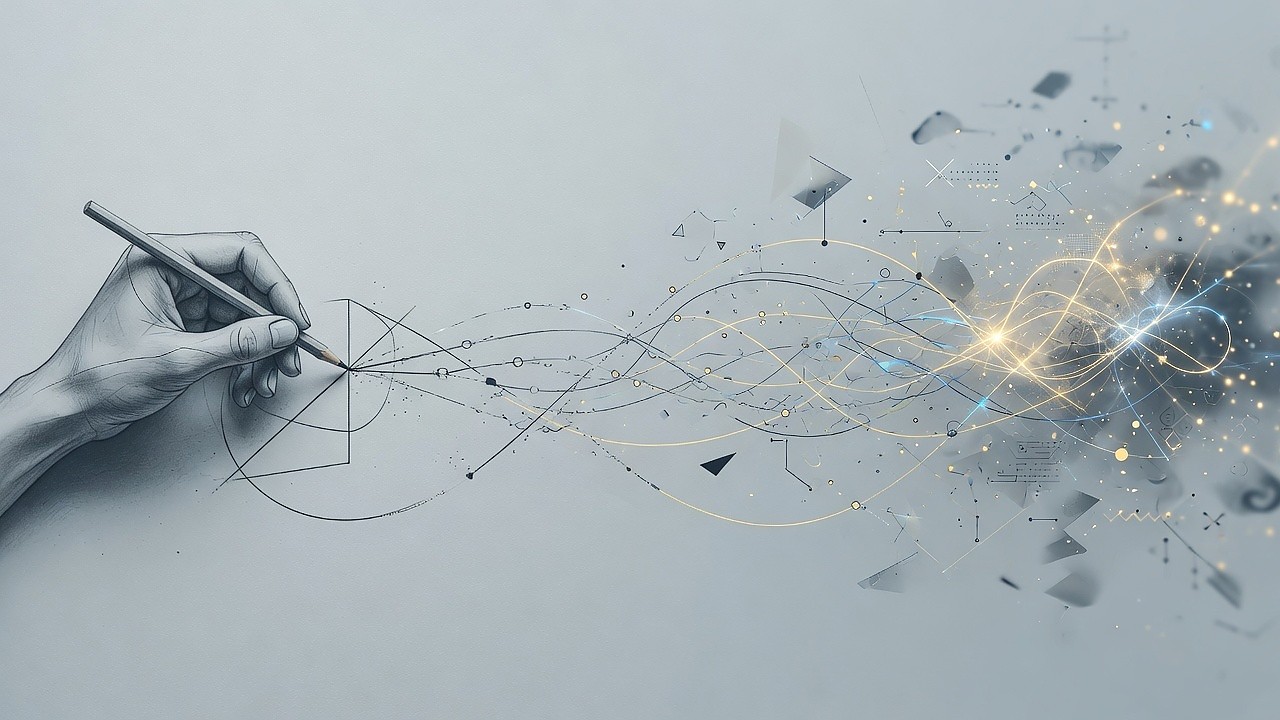
The concepts of reproducibility, authenticity, appropriation, authorship, and originality become particularly relevant in a context where images, texts and ideas may be generated by algorithmic systems. In this sense, artificial intelligence appears to extend transformations already initiated through mechanical reproduction, as well as through the processes of digitalisation and the democratisation of culture.
Indeed, whereas mechanical reproduction previously altered how artworks were reproduced and distributed through media such as photography, cinema, or print, algorithmic generation now seems to render the very origin of the work increasingly diffuse.
The discussion surrounding originality finds an important framework in Walter Benjamin’s The Work of Art in the Age of Mechanical Reproduction (1935), in which the author argues that the mechanical reproduction of the artwork leads to the loss of its aura - that is, its authenticity and uniqueness. For Benjamin, the possibility of reproducing a work infinitely alters its relationship with time, space, and aesthetic experience. Although the work may still possess an identifiable origin, its mass distribution and dissemination progressively diminish the distinction between original and copy.
Roland Barthes, in The Death of the Author (1967), questions the centrality of authorship as the sole and definitive origin of a work’s meaning. For Barthes, the text should not be interpreted exclusively through authorial intention, but rather as a space composed of multiple references, readings, and interpretations. By detaching the text from the authority of the author, the work ceases to depend upon a fixed origin and instead becomes an open field of meanings, in which the reader assumes a central role in the construction of significance. In this context, the relationship between creation, meaning, and origin becomes progressively more diffuse.
Similarly, Jean Baudrillard, in Simulacra and Simulation (1981), argues that in the age of media and the continuous reproduction of images, reality increasingly becomes indistinguishable from its own representation. According to the author, images gradually cease to refer to an original reality and instead endlessly reproduce one another. It is within this framework that the concept of the simulacrum emerges: a sign or representation that no longer corresponds to any identifiable original but instead acquires autonomy through its constant reproduction and circulation. From this perspective, generative artificial intelligence appears to intensify this logic, producing content whose origin becomes ever more difficult to define, progressively blurring the boundaries between creation, reproduction and simulation.
Considering this reality, the question of originality becomes particularly complex. Artificial intelligence systems are trained on vast quantities of information, learning patterns, relationships, and structures present within pre-existing images, texts, and cultural productions. Although the content they generate may appear novel, it inevitably results from the reorganisation of previous references and patterns, making it increasingly difficult to identify a singular or entirely original source. In some respects, this process resembles the way human memory itself is constructed through the accumulation of experiences, the association of ideas, and the continual retention of references over time. However, whereas human creation may still reveal an identifiable experience, intention, or individual trajectory, in algorithmic generation, the origin of creation becomes increasingly opaque and difficult to delineate.
Artificial intelligence does not necessarily represent the end of creativity or originality, but it profoundly transforms the way in which creative value is assigned. Historically, the distinction between artist and artisan contributed to the progressive valorisation of authorship, individual vision, and the conceptual dimension of artistic creation, beyond mere technical execution. Later, with conceptual art, the value of the work shifted even further away from materiality and technique towards the idea and the meaning attributed to creation. In an environment where images, texts, and ideas may be generated almost instantaneously, originality seems to depend increasingly less upon the technical capacity to produce, and more upon the concept, intention, and context that frame the work.
In conclusion, generative artificial intelligence challenges not only the authenticity of the artwork and the centrality of the author, but also the very notion of originality as something entirely unprecedented. If all production emerges from the continual reorganisation of previous references, then perhaps the question is no longer how to distinguish between original and copy, but rather what continues to confer meaning and value upon creation in a context where everything appears capable of being generated.
Bibliographic references
Barthes, R. (1988). The Death of the Author. Edições 70. (Original work published 1967)
Baudrillard, J. (1991). Simulacra and Simulation. Relógio d’Água. (Original work published 1981)
Benjamin, W. (2012). The Work of Art in the Age of Mechanical Reproduction. Assírio & Alvim. (Original work published 1935)
Chiang, T. (2024, 9 February). “Why A.I. Isn’t Going to Make Art.” The New Yorker. https://www.newyorker.com/culture/the-weekend-essay/why-ai-isnt-going-to-make-art
Fisher, M. (2009). Capitalist Realism: Is There No Alternative? Zero Books.
IBM – International Business Machines Corporation. (n.d.). “AI Agent Memory.” IBM Think. Accessed 15 May 2026, from https://www.ibm.com/br-pt/think/topics/ai-agent-memory?regionCode=br&languageCode=pt&cm-history=br-pt
Observador. (2020, 14 November). “Death, Autopsy and Life After Death.” Observador. https://observador.pt/opiniao/morte-autopsia-e-vida-depois-da-morte/