From Canvas to Conversation: The new Claude Design
For a while, Claude wasn’t a tool most designers naturally gravitated towards.Designers are visual by nature.
For a while, Claude wasn’t a tool most designers naturally gravitated towards.Designers are visual by nature.
They think in layouts, spacing, hierarchy, and composition. Tools like Figma sit right inside that way of working. Claude, on the other hand, lived somewhere else. It was strong at thinking, writing, structuring ideas but it wasn’t a visual tool. There was no canvas to push pixels around, no direct sense of “seeing” the design take shape.
That changed this weekend.
Anthropic just launched Claude Design: a new way of creating interfaces where you no longer start with a blank canvas, where you start with a sentence.
Instead of building layouts piece by piece, you just describe what you want and within seconds, a structured design appears, ready to refine. At first, it feels like another AI upgrade with faster workflows, easier prototyping. But there’s something deeper going on underneath.
Design is no longer something you draw. It’s becoming something you talk to.
From drawing to directing, from control to conversation
The easiest way to understand this shift is to think of design less like drawing, and more like directing.
In a traditional workflow, you are inside the work, placing every element, adjusting every margin, controlling each detail like someone painting frame by frame. But with tools like Claude Design, that relationship changes. You’re no longer building everything from scratch; you’re guiding something that’s already forming in front of you.
You set the tone. You define direction. You respond to what appears.
make it feel lighter”
“more breathing room”
“less corporate, more human”
And the design shifts accordingly.
The process becomes a loop: describe, see, adjust, repeat. Control doesn’t disappear, it changes shape. It moves from direct manipulation to guidance through language.
You’re still designing. But instead of working on a canvas, you’re working through conversation, less a builder of every detail, more a director of how everything comes together.
More options, harder decisions
One of the most immediate changes is speed. Where you might once explore a few directions, you can now generate many in seconds. Entire design approaches can appear almost instantly, ready to be compared, adjusted, or discarded. This feels powerful, and in many ways it is. But it also changes the nature of decision-making. Because when everything becomes possible, the challenge is no longer generating ideas. It becomes choosing between them, and that choice becomes the real skill.
The work shifts from creating options to recognizing which ones matter.
The dark side of the Moon
There is also a quieter effect that comes with this kind of speed. If many people start asking for similar things, such as “clean,” “modern,” “minimal”, the outputs begin to converge. Different products, different ideas, but visually similar outcomes. Not because the tool is limiting creativity, but because language itself tends to drift toward familiar patterns.
The risk is not bad design. It’s repetition.
And in that environment, taste becomes more important than ever. Not just the ability to generate ideas, but the ability to recognise what feels distinct, intentional, and alive.
What still matters
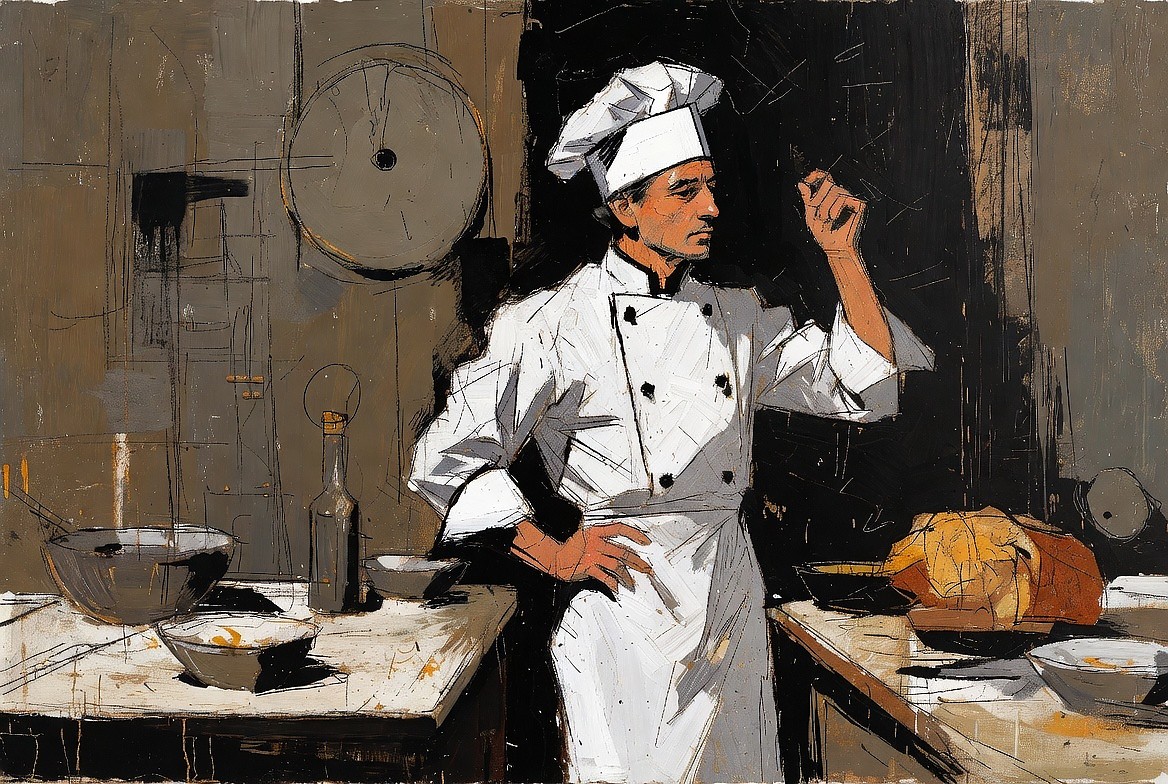
Even as the process evolves, the fundamentals of design remain unchanged. Clarity, emotion, and intention stay at the core of any design. What is changing is the role of the designer: from carpenter to master builder, from commis to chef, from executor to creative director, increasingly focused on decisions rather than execution. Knowing what to ask for, what to refine, what to preserve, and what to eliminate becomes essential.
It is curious that, as technology evolves, we seem to return to something as fundamental to human evolution as language itself. There is a certain dichotomy here: the more we advance technologically, the closer we move to the most basic act of all: communicating to build.